
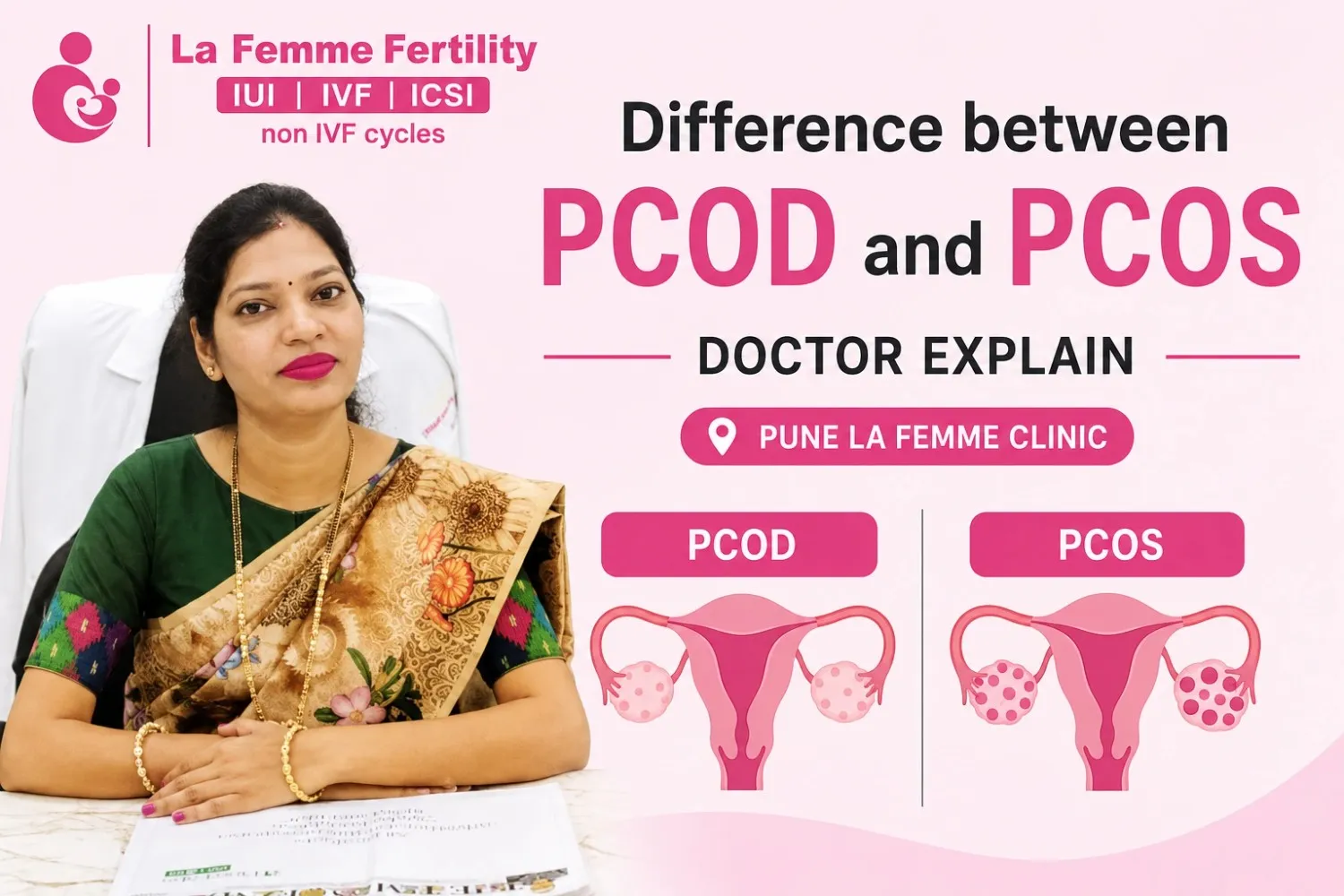
KEY TAKEAWAYS FOR PCOD & PCOS
- PCOD and PCOS are related but distinct conditions; PCOS is a more complex hormonal disorder with broader metabolic implications.
- PCOD occurs when the ovaries release immature eggs, causing them to accumulate as cysts; it is more common and generally milder.
- PCOS is an endocrine disorder involving elevated androgens, irregular cycles and metabolic effects including insulin resistance.
- Most women with PCOD can conceive with lifestyle changes; PCOS often requires more targeted hormonal or fertility treatment.
- Both conditions respond well to early diagnosis, appropriate management and sustained lifestyle modification.
- Dr. Bhagyashri Naphade at La Femme Fertility Clinic, Viman Nagar, provides accurate PCOD and PCOS diagnosis and management.
PCOD and PCOS are terms used interchangeably by many patients and even some healthcare providers, but they are not exactly the same condition. Understanding the difference matters because it changes the treatment approach significantly.
Dr. Bhagyashri Naphade at La Femme Fertility Clinic, Wakad, provides this clear, clinically accurate explanation for women in Pune and PCMC who deserve to understand their diagnosis fully.
Quick Facts: PCOD and PCOS in Pune
| Parameter | PCOD | PCOS |
| Prevalence in Indian women | More common | Less common but more serious |
| Core issue | Immature egg release, ovarian cysts | Hormonal imbalance (high androgens), endocrine disorder |
| Fertility impact | Milder; conception often achievable | Greater; may need medical support |
| Metabolic effects | Minimal | Insulin resistance, diabetes risk |
| Reversal | Often reversible | Managed, not fully cured |
| Consultation at La Femme | INR 600 | INR 600 |
PCOD and PCOS in India: 2025–2026 Statistics
| Metric | Data Point | Source |
| PCOS prevalence in Indian women | 15 to 20 percent | ICMR 2023 |
| PCOD prevalence (broader category) | Higher; exact data mixed with PCOS stats | Industry estimate |
| PCOS and insulin resistance | 50 to 70 percent of PCOS cases | Industry estimate |
| PCOS and infertility link | 30 to 40 percent of infertile women | ICMR data |
| Undiagnosed PCOD or PCOS | Approx. 70 percent remain undiagnosed | Industry estimate |
| Women confusing PCOD and PCOS | Very common in urban India | Observational |
PCOD in Detail: What Actually Happens?
In PCOD, the ovaries produce multiple immature or partially mature eggs during a cycle. These fail to be released normally and instead accumulate as small cysts within the ovary. The ovaries often enlarge slightly. PCOD is frequently triggered or worsened by hormonal fluctuations, unhealthy diet, stress and a sedentary lifestyle. Many women with PCOD maintain relatively regular periods and can conceive naturally with lifestyle adjustments.
PCOS in Detail: Why It’s More Complex
PCOS is classified as an endocrine disorder. The defining features are elevated androgens (male hormones like testosterone), irregular or absent ovulation and polycystic-appearing ovaries on ultrasound. To be diagnosed with PCOS, a patient needs at least two of these three features (Rotterdam Criteria). This means you can have PCOS without visible cysts on the ovary.
The metabolic effects of PCOS extend far beyond the ovaries. Insulin resistance is present in 50 to 70 percent of cases, raising long-term risks of Type 2 diabetes, cardiovascular disease and, if untreated over decades, endometrial hyperplasia.
Difference between PCOD and PCOS 2026
| Feature | PCOD | PCOS |
| Nature | Functional; ovarian dysfunction | Endocrine disorder |
| Hormonal imbalance | Mild | Significant; elevated androgens |
| Menstrual pattern | Irregular but often less severe | Irregular or absent; anovulatory |
| Ovarian appearance | Multiple small cysts | Polycystic on ultrasound (not required for diagnosis) |
| Insulin resistance | Less common | 50 to 70 percent of cases |
| Long-term risks | Lower | Higher; diabetes, heart disease |
| Fertility impact | Milder; often natural conception possible | Greater; may need IUI or IVF |
| Treatment | Lifestyle, hormonal pills if needed | Lifestyle plus medical management; sometimes ART |
Can You Have Both PCOD and PCOS?
The two conditions overlap significantly and many gynaecologists use the terms interchangeably in clinical practice. In strict academic terms, PCOS is the broader diagnosis. PCOD can be seen as a sub-set of ovarian dysfunction that does not meet all criteria for full PCOS. If you’ve received both diagnoses from different doctors, the practical step is to get a complete hormonal panel and current ultrasound reviewed by a specialist who can give you one clear, accurate diagnosis.
Treatment: How It Differs for PCOD vs PCOS
| Treatment Component | For PCOD | For PCOS |
| Lifestyle (diet, exercise) | Core; often sufficient in mild cases | Essential; but rarely sufficient alone |
| Hormonal contraceptives | Regulate cycles if needed | Regulate cycles and reduce androgens |
| Metformin | Less commonly needed | Used for insulin resistance |
| Ovulation induction | If trying to conceive | Often needed alongside metformin |
| IVF or IUI | Rarely needed as first line | May be needed if ovulation induction fails |
| Long-term monitoring | Annual | Annual + metabolic screening (glucose, lipids) |
PCOD and PCOS Management at La Femme Fertility Clinic, Wakad
La Femme Fertility Clinic in Wakad provides comprehensive hormonal, metabolic and fertility-focused management for both PCOD and PCOS. Women from Hinjewadi, Pimpri, Chinchwad, Baner, Rahatani and Thergaon choose La Femme for specialist gynaecological care without the need to travel to central Pune.
Frequently Asked Questions
Q: Should I use the term PCOD or PCOS when speaking to my doctor?
Use whichever term your previous doctor used and bring your test reports. Your specialist at La Femme will clarify the accurate diagnosis based on your hormonal panel and ultrasound.
Q: Can PCOD become PCOS?
PCOD and PCOS represent a spectrum. Without lifestyle management, PCOD can progress in severity and develop features consistent with PCOS. Early management is the most effective prevention.
Q: Is PCOS a lifelong condition?
PCOS is a chronic hormonal condition. Its symptoms are highly manageable with the right combination of lifestyle changes and medical treatment, but it doesn’t disappear on its own.
Q: Can thin women have PCOS?
Yes. Lean PCOS, where a woman has normal BMI but elevated androgens and irregular cycles, affects approximately 20 to 30 percent of PCOS patients. Insulin resistance can be present in lean PCOS as well.
Q: What is the cost of PCOS or PCOD evaluation at La Femme Fertility Clinic?
Consultation at La Femme is INR 600. A complete diagnostic workup including hormonal panel and pelvic ultrasound costs approximately INR 3,000 to INR 8,000 in Pune.
Conclusion
PCOD and PCOS are related but distinct conditions. PCOD is generally milder and more responsive to lifestyle changes alone. PCOS is a more complex endocrine disorder with metabolic implications that require sustained management. Both conditions respond well to early diagnosis and appropriate care.
If you have been told you have PCOD or PCOS in Wakad or PCMC, book a consultation with Dr. Bhagyashri Naphade at La Femme Fertility Clinic to get a clear, accurate diagnosis and a personalised treatment plan.
Visit lafemmeivf at wakad & Viman Nagar Branch

Dr. Bhagyashree Naphade
Dr. Bhagyashri Naphade is a highly trusted lady gynecologist and IVF specialist in Wakad, Pune, with an overall 20 years of practice and 10 years of experience as a gynecologist IVF specialist. Internationally trained in IVF from Germany and an ASRM award winner, she specializes in IVF, IUI, PCOD/PCOS, and women’s health.
