
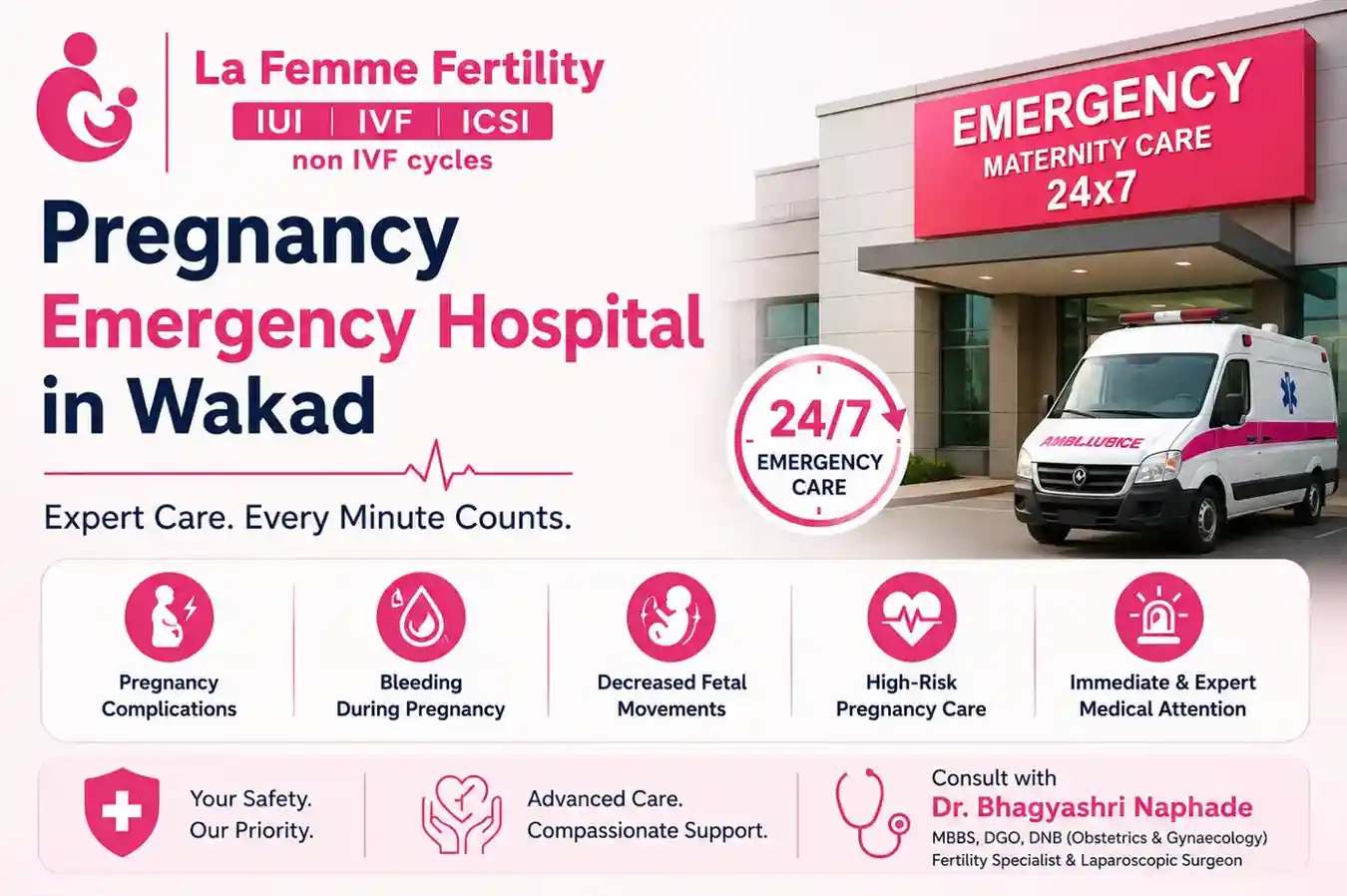
La Femme Fertility in Wakad, Pune, offers pregnancy emergency care and high-risk obstetric management under Dr. Bhagyashri Naphade, an ASRM award-winning specialist with 21 years of experience. The clinic provides urgent gynaecological consultations, high-risk pregnancy monitoring, and immediate referral coordination for obstetric emergencies in Wakad and surrounding PCMC areas.
A pregnancy emergency does not come with a warning. It can happen at 10 weeks or at 36 weeks. It can feel like sharp abdominal pain at midnight, a sudden gush of fluid, bleeding that will not stop, or a baby that has stopped moving. In those moments, the only question that matters is: where is the nearest pregnancy emergency hospital in Wakad, and can I trust the care I will receive?
If you are pregnant and living in Wakad, Thergaon, Hinjawadi, Pimple Saudagar, or the surrounding PCMC areas, this guide gives you the information you need before an emergency happens — not during one. It covers the warning signs that need immediate attention, what constitutes a true obstetric emergency, how to respond, and where to turn for specialist pregnancy care in Wakad.
La Femme Fertility in Wakad is led by Dr. Bhagyashri Naphade, an ASRM award-winning infertility and high-risk pregnancy specialist with over 21 years of clinical experience and international training from Germany. The clinic provides comprehensive obstetric care, high-risk pregnancy monitoring, and gynaecological emergency consultations for women across Pune and PCMC. Full details are at lafemmeivf.in.
What Counts as a Pregnancy Emergency?
Not every discomfort in pregnancy is an emergency — but some symptoms require immediate medical attention regardless of the time or day. Knowing the difference can protect both mother and baby.
IMPORTANT: If you experience any of the symptoms listed below, do not wait for your next scheduled appointment. Contact your gynaecologist immediately or go directly to the nearest obstetric facility.
Bleeding During Pregnancy
Any vaginal bleeding during pregnancy must be evaluated promptly. In the first trimester, bleeding may indicate a threatened miscarriage or an ectopic pregnancy — both of which require urgent assessment. In the second and third trimesters, bleeding can signal placenta praevia or placental abruption, conditions that carry serious risk to mother and baby if not managed immediately.
• Light spotting in early pregnancy — call your doctor the same day
• Heavy bleeding at any stage — go to a hospital immediately
• Bleeding after 20 weeks — treat as an emergency
Severe Abdominal or Pelvic Pain
Mild cramping is common in early pregnancy. Severe, persistent, or one-sided abdominal pain is not. Sharp pain in the lower right or left abdomen in the first trimester can indicate an ectopic pregnancy — a potentially life-threatening condition in which the embryo implants outside the uterus. Later in pregnancy, severe abdominal pain accompanied by hardness of the uterus may indicate placental abruption.
Reduced or Absent Foetal Movement
After 28 weeks, a baby should move regularly. A significant reduction in foetal movements — particularly if you count fewer than 10 movements in two hours when the baby is normally active — requires same-day assessment. An absence of movement for an extended period is a serious warning sign.
Signs of Preeclampsia
Preeclampsia is a pregnancy complication characterised by high blood pressure and signs of organ damage. It typically develops after 20 weeks and can progress rapidly to eclampsia — a life-threatening condition involving seizures.
• Sudden severe headache that does not resolve
• Visual disturbances — blurring, flashes, or spots
• Swelling of the face, hands, or feet that appears suddenly
• Upper abdominal pain, particularly under the right ribs
• Blood pressure reading above 140/90 on two occasions
Premature Labour
Regular contractions before 37 weeks of pregnancy may indicate premature labour. Symptoms include rhythmic tightening of the abdomen, lower back pain that comes and goes, pelvic pressure, or a change in vaginal discharge. Premature labour requires immediate hospital assessment because early intervention can delay delivery and improve outcomes for the baby.
Rupture of Membranes
If your waters break before 37 weeks, or if there is a continuous trickle of fluid at any stage, contact your doctor immediately. The amniotic sac protects the baby from infection. Once the membranes rupture, the risk of infection increases with every passing hour.
High Fever
A temperature above 38 degrees Celsius during pregnancy warrants same-day medical evaluation. Infections during pregnancy — including urinary tract infections, chorioamnionitis, and COVID-19 — can affect foetal wellbeing and require prompt treatment.
Pregnancy Warning Signs and How Urgently to Act
| Symptom | Urgency Level | Action |
| Heavy vaginal bleeding | Emergency | Go to hospital immediately |
| Absent foetal movement (>2 hrs) | Emergency | Go to hospital immediately |
| Severe headache + visual changes | Emergency | Go to hospital immediately — may be preeclampsia |
| Regular contractions before 37 wks | Emergency | Go to hospital immediately |
| Waters breaking before 37 wks | Emergency | Go to hospital immediately |
| One-sided pelvic pain (1st trimester) | Urgent | Call doctor now — rule out ectopic |
| Light spotting (1st trimester) | Same day | Call your gynaecologist today |
| Fever above 38°C | Same day | Call your gynaecologist today |
| Reduced foetal movement | Same day | Call your gynaecologist today |
| Mild swelling of ankles | Routine review | Mention at next appointment |
High-Risk Pregnancy: When Ongoing Monitoring Is the Emergency Plan
Not all pregnancy emergencies are sudden. Some pregnancies carry an elevated risk from the outset — and for these women, the “emergency plan” is not reactive. It is a structured, proactive monitoring protocol that catches complications before they become crises.
A pregnancy is classified as high risk when the mother or baby has a condition that increases the chance of complications during pregnancy or delivery. High-risk pregnancies require more frequent monitoring, specialist-level care, and a clearly defined escalation plan.
Common Conditions That Make a Pregnancy High Risk
• Maternal age over 35 at delivery
• Pre-existing diabetes (Type 1 or Type 2) or gestational diabetes
• Pre-existing hypertension or a history of preeclampsia in a previous pregnancy
• Thyroid disorders — both hypothyroidism and hyperthyroidism
• PCOD/PCOS with hormonal imbalance in early pregnancy
• Multiple pregnancy (twins, triplets)
• Placenta praevia or low-lying placenta
• History of recurrent miscarriages (two or more)
• History of preterm birth in a previous pregnancy
• Uterine fibroids or structural uterine abnormalities
• Foetal growth restriction or structural abnormalities detected on ultrasound
• IVF-conceived pregnancy — requires closer monitoring in the first trimester
At La Femme Fertility in Wakad, Dr. Bhagyashri Naphade provides dedicated high-risk pregnancy management with individualised monitoring protocols for each patient. Full details are available on the High-Risk Pregnancy Management page.
What to Expect at a Pregnancy Emergency Consultation in Wakad
If you arrive at a gynaecology clinic or obstetric unit in Wakad with a pregnancy concern, here is what a proper emergency assessment involves. Understanding this helps you ask the right questions and feel less overwhelmed.
1. Initial Triage
A trained nurse or doctor will assess your blood pressure, pulse, temperature, and oxygen saturation. You will be asked about the symptom — when it started, how severe it is, and whether there are any associated symptoms. In the case of bleeding, the volume and colour are noted.
2. Foetal Heart Rate Monitoring
A cardiotocograph (CTG) monitor may be applied to record the baby’s heart rate and any uterine activity. This provides real-time information about foetal wellbeing and is one of the most important assessments in obstetric emergency care.
3. Ultrasound Assessment
An urgent ultrasound will be performed to check the baby’s position, placental location, amniotic fluid levels, and foetal movement. In early pregnancy, a transvaginal ultrasound may be needed to assess the foetal heartbeat and rule out ectopic pregnancy.
4. Blood and Urine Tests
Depending on the presenting concern, blood tests may include a full blood count, coagulation screen, blood group and cross-match, liver function, kidney function, and uric acid levels (for preeclampsia). A urine dipstick test is done to check for protein, which is a marker of preeclampsia.
5. Clinical Decision
Based on the assessment, the doctor will either discharge with clear instructions and a follow-up appointment, admit for observation and further monitoring, or arrange an urgent transfer to a higher-level facility if surgical intervention or neonatal intensive care is required.
Pregnancy Care at La Femme Fertility, Wakad
La Femme Fertility is a specialist fertility and gynaecology clinic in Wakad, Pune, founded by Dr. Bhagyashri Naphade. With 21 years of clinical experience, training at Apollo Cradle Bangalore, international IVF training from Germany, and an ASRM research award, Dr. Naphade brings specialist-level expertise to every aspect of women’s reproductive health — including obstetric emergencies and high-risk pregnancy management.
The clinic serves women from Wakad, Thergaon, Hinjawadi, Pimple Saudagar, Pimple Nilakh, Ravet, Aundh, and across PCMC. It offers:
• High-risk pregnancy monitoring with individualised protocols
• IVF pregnancy support with close first-trimester surveillance
• Urgent same-day gynaecological consultations for pregnancy concerns
• Management of threatened miscarriage and recurrent pregnancy loss
• PCOD management in pregnancy
• Hypertension and diabetes in pregnancy
• Laparoscopic surgery during pregnancy when clinically necessary
• Coordination with tertiary hospitals for cases requiring inpatient obstetric or neonatal care
For the Wakad branch address, timings, and contact information, visit the La Femme Fertility Wakad branch page.
How to Prepare Before a Pregnancy Emergency Happens
The best time to plan for a pregnancy emergency is before one occurs. These steps take minutes to prepare and can save critical time when it matters most.
1. Save the Right Numbers
• Your gynaecologist’s direct contact number — not just the clinic landline
• The clinic’s after-hours or emergency contact number
• The number of the nearest hospital with a 24-hour obstetric unit
• A trusted family member or friend who can drive you or accompany you
2. Know Your Blood Group
Keep a note of your blood group and Rh factor somewhere accessible — on your phone, in your wallet, and in your pregnancy file. In the event of significant bleeding, this information is needed immediately by the treating team.
3. Carry Your Pregnancy Documents
From 28 weeks onward, carry a copy of your most recent ultrasound report and your last two or three antenatal visit records whenever you travel far from home. In an emergency at an unfamiliar facility, this information allows the treating doctor to make faster, safer decisions.
4. Know the Warning Signs
Review the symptom table in this blog and share it with your partner and the family member most likely to be with you during an emergency. The person accompanying you needs to be able to communicate your symptoms clearly to the medical team.
5. Do Not Wait and Watch for Serious Symptoms
The most common factor that worsens obstetric outcomes is delayed presentation. Many women wait for hours with serious symptoms — hoping things will resolve — before seeking care. If you are unsure whether a symptom is serious, call your gynaecologist. A brief phone call is always better than a delayed emergency presentation.
Frequently Asked Questions
1. Which is the best pregnancy emergency hospital in Wakad?
La Femme Fertility in Wakad, led by Dr. Bhagyashri Naphade, provides specialist obstetric consultations, high-risk pregnancy monitoring, and urgent gynaecological care for women across Wakad and PCMC. For emergencies requiring inpatient obstetric or surgical care, Dr. Naphade coordinates with tertiary care hospitals in Pune.
2. What should I do if I have bleeding during pregnancy?
Light spotting in the first trimester should be reported to your gynaecologist the same day. Heavy bleeding at any stage of pregnancy is a medical emergency — go to the nearest hospital immediately. Do not wait to see if it resolves on its own.
3. Is La Femme Fertility open for urgent consultations in Wakad?
Yes. La Femme Fertility in Wakad provides urgent same-day consultations for pregnancy concerns. Contact the clinic directly for appointment availability. For the Wakad branch address and contact number, visit lafemmeivf.in/wakad-branch/.
4. Can I manage a high-risk pregnancy at a fertility clinic in Wakad?
Many aspects of high-risk pregnancy monitoring — including blood pressure management, blood sugar monitoring, thyroid function, ultrasound surveillance, and foetal Doppler — can be managed at a specialist gynaecology clinic in Wakad. Cases requiring hospitalisation or neonatal intensive care are managed in coordination with tertiary facilities.
5. What is the difference between a high-risk pregnancy and a normal pregnancy?
A high-risk pregnancy is one in which the mother or baby has a condition that increases the likelihood of complications. Common risk factors include maternal age over 35, pre-existing diabetes or hypertension, multiple pregnancy, IVF conception, and a history of preterm birth or miscarriage. High-risk pregnancies require more frequent monitoring and specialist-level oversight rather than standard antenatal care alone.
Have a Pregnancy Concern in Wakad? Do Not Wait
Dr. Bhagyashri Naphade at La Femme Fertility, Wakad, Pune provides urgent obstetric consultations and high-risk pregnancy care
for women across Wakad, Hinjawadi, Thergaon, and PCMC. 21 Years of Experience | ASRM Award-Winning Specialist

Dr. Bhagyashree Naphade
Dr. Bhagyashri Naphade is a highly trusted lady gynecologist and IVF specialist in Wakad, Pune, with an overall 20 years of practice and 10 years of experience as a gynecologist IVF specialist. Internationally trained in IVF from Germany and an ASRM award winner, she specializes in IVF, IUI, PCOD/PCOS, and women’s health.
