
KEY TAKEAWAYS
- IVF and ICSI are both in vitro fertilisation methods; the key difference is how sperm meets egg in the laboratory.
- ICSI is recommended when male factor infertility is present, with success rates similar to standard IVF in well-equipped labs.
- In Pune, ICSI adds INR 30,000 to INR 50,000 to the base IVF cycle cost.
- About 40 to 50 percent of infertility cases in Indian couples involve a male factor, making ICSI highly relevant.
- Your specialist at La Femme Clinic will determine which method suits your case after a complete couple workup.
- Both IVF and ICSI are performed in a fully equipped embryology lab under Dr. Bhagyashri Naphade’s supervision.
IVF vs ICSI is one of the most common questions couples in Pune ask when they first visit a fertility clinic. Both are powerful treatments for infertility but they work differently and are suited to different clinical situations.
This guide, reviewed by Dr. Bhagyashri Naphade at La Femme Fertility Clinic, Wakad, gives you a clear, jargon-free comparison so you can have a more informed conversation with your specialist.
Quick Facts: IVF and ICSI in Pune 2026
| Parameter | Details |
| Base IVF cycle cost in Pune | INR 80,000 to INR 1,40,000 (excluding medications) |
| ICSI add-on cost | INR 30,000 to INR 50,000 |
| Male infertility contribution to couple infertility | 40 to 50 percent (ICMR data) |
| IVF success rate under 35 in Pune | 50 to 65 percent per cycle |
| ICSI success rate (experienced labs) | Comparable to or marginally above IVF |
| Both available at La Femme Clinic | Yes – Wakad, Pune |
Pune Fertility Treatment Statistics 2025–2026
| Metric | Data Point | Source |
| Infertility prevalence in India | 10 to 15 percent of couples | ICMR 2023 |
| ICSI as proportion of all IVF cycles in India | 55 to 60 percent | Industry estimate |
| Male factor infertility cases in India | 40 to 50 percent of couple infertility | ICMR data |
| Average IVF success rate across Indian clinics | 40 to 50 percent per cycle | Industry estimate |
| Couples seeking IVF in PCMC annually | Approx. 1,500 to 2,000 | Industry estimate |
| IVF cycles with ICSI add-on in urban India | Rising; approx. 60 percent | Industry estimate |
What Is IVF?
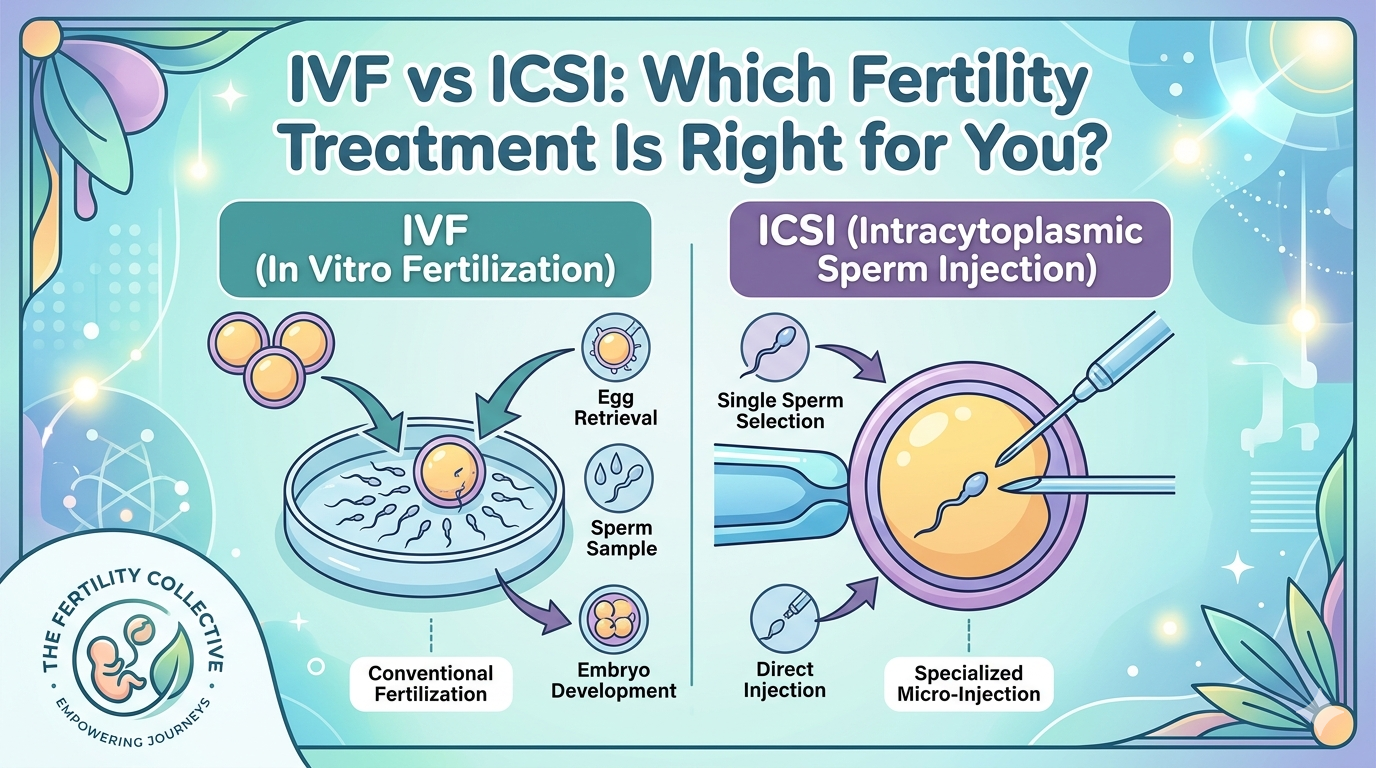
In standard IVF (In Vitro Fertilisation), eggs are retrieved from the woman’s ovaries after stimulation and placed in a laboratory dish with a prepared sample of sperm. Fertilisation happens naturally in the dish, with sperm selecting and penetrating the egg on their own.
IVF is the foundation of all assisted reproduction and works well when sperm quality is normal to moderately reduced. The resulting embryos are cultured for 3 to 5 days and then transferred to the uterus.
What Is ICSI?
ICSI (Intracytoplasmic Sperm Injection) takes fertilisation one step further. A single, carefully selected sperm is injected directly into each mature egg using a microscopic glass needle. This step is performed by a trained embryologist in the lab and takes place on the day of egg retrieval.
ICSI eliminates the need for sperm to penetrate the egg independently, making it the preferred choice when sperm count, motility or morphology is significantly compromised.
IVF vs ICSI: Side-by-Side Comparison
| Factor | IVF | ICSI |
| Fertilisation method | Sperm and eggs mixed in dish | Single sperm injected into each egg |
| Best suited for | Unexplained infertility, mild male factor | Moderate to severe male infertility |
| Sperm requirement | Thousands of motile sperm needed | Even one viable sperm is sufficient |
| Fertilisation rate | 60 to 70 percent of mature eggs | 70 to 80 percent of mature eggs |
| Lab requirement | Standard IVF lab | Requires micromanipulation equipment |
| Additional cost in Pune | Base cycle cost | Adds INR 30,000 to INR 50,000 |
| Success rates per cycle | 50 to 65 percent (under 35, Pune) | Comparable; marginally higher in male factor cases |
When Does Your Doctor Choose ICSI Over IVF?
Your specialist will recommend ICSI when the semen analysis shows any of the following: a sperm count below 15 million per millilitre, motility below 40 percent, normal morphology below 4 percent (Kruger criteria), previous failed fertilisation in a standard IVF cycle, or when surgical sperm retrieval (TESE or PESA) is used.
Can a normal-fertility couple still choose ICSI? Technically yes, but responsible clinics like La Femme Fertility Clinic recommend ICSI only when there is a clinical indication, as unnecessary procedures add cost without proven additional benefit.
The Emotional Dimension: What ICSI Means for Couples
Learning that male factor infertility is contributing to the challenge of conceiving can feel overwhelming, especially in Indian families where the conversation around male fertility remains uncomfortable. At La Femme Fertility Clinic in Wakad, Dr. Bhagyashri Naphade ensures both partners are counselled together, with compassion and clinical clarity.
Consider Rohan and Sneha from Pimpri-Chinchwad, who came to La Femme after two years of trying. Rohan’s semen analysis showed low motility. With ICSI, they achieved pregnancy on the first cycle. The right information and the right treatment made all the difference.
IVF and ICSI at La Femme Fertility Clinic, Wakad
La Femme Fertility Clinic in Wakad is equipped with a state-of-the-art embryology lab offering both standard IVF and ICSI procedures under the expert supervision of Dr. Bhagyashri Naphade. Patients from Baner, Aundh, Rahatani, Hinjewadi and Thergaon access the clinic conveniently for all stages of their fertility treatment.
IVF vs ICSI: Cost Comparison in Pune 2026
| Procedure | Base Cycle Cost (Excl. Medications) | With Medications (Approx.) |
| Standard IVF | INR 80,000 to INR 1,40,000 | INR 1,10,000 to INR 2,20,000 |
| IVF + ICSI | INR 1,10,000 to INR 1,90,000 | INR 1,40,000 to INR 2,70,000 |
| Frozen Embryo Transfer (FET) | INR 25,000 to INR 50,000 | INR 40,000 to INR 70,000 |
| Consultation at La Femme | INR 600 per visit | Applicable to all cases |
Frequently Asked Questions
Q: Is ICSI better than IVF for all cases?
No. ICSI is specifically recommended for male factor infertility. For couples with normal sperm parameters, standard IVF produces equivalent results at lower cost.
Q: Does ICSI increase the risk of birth defects?
Current evidence from organisations including WHO and ASRM indicates no significant increase in major birth defects with ICSI compared to standard IVF. Your doctor will discuss individual risk factors during counselling.
Q: How long does the IVF or ICSI process take in Pune?
A complete fresh IVF or ICSI cycle takes approximately 3 to 4 weeks from the start of ovarian stimulation to embryo transfer.
Q: What is the difference in success rate between IVF and ICSI?
In cases with male factor infertility, ICSI typically achieves higher fertilisation rates (70 to 80 percent vs 60 to 70 percent for IVF). Overall pregnancy rates per transfer are comparable when the female partner’s uterine and egg quality is good.
Q: Can I do ICSI with frozen sperm?
Yes. ICSI is routinely performed with frozen sperm, whether from a previous collection or from surgical retrieval, making it suitable for a wide range of male infertility scenarios.
Q: How do I know if I need ICSI?
A semen analysis is the first step. Based on the results, Dr. Bhagyashri Naphade at La Femme Fertility Clinic will recommend either standard IVF or IVF with ICSI.
Conclusion
IVF vs ICSI is not a competition. Both are effective fertility treatments and the right choice depends entirely on the clinical picture of each couple. Standard IVF works well for most cases of unexplained infertility while ICSI is the superior option when male factor is confirmed.
At La Femme Fertility Clinic in Wakad, Dr. Bhagyashri Naphade will evaluate your complete couple profile and recommend the most appropriate and cost-effective path to pregnancy.
Book your first consultation today at lafemmeivf
Her 20+ years of experience and Germany-certified IVF expertise ensure you receive a truly personalised recommendation.

Dr. Bhagyashree Naphade
Dr. Bhagyashri Naphade is a highly trusted lady gynecologist and IVF specialist in Wakad, Pune, with an overall 20 years of practice and 10 years of experience as a gynecologist IVF specialist. Internationally trained in IVF from Germany and an ASRM award winner, she specializes in IVF, IUI, PCOD/PCOS, and women’s health.
