
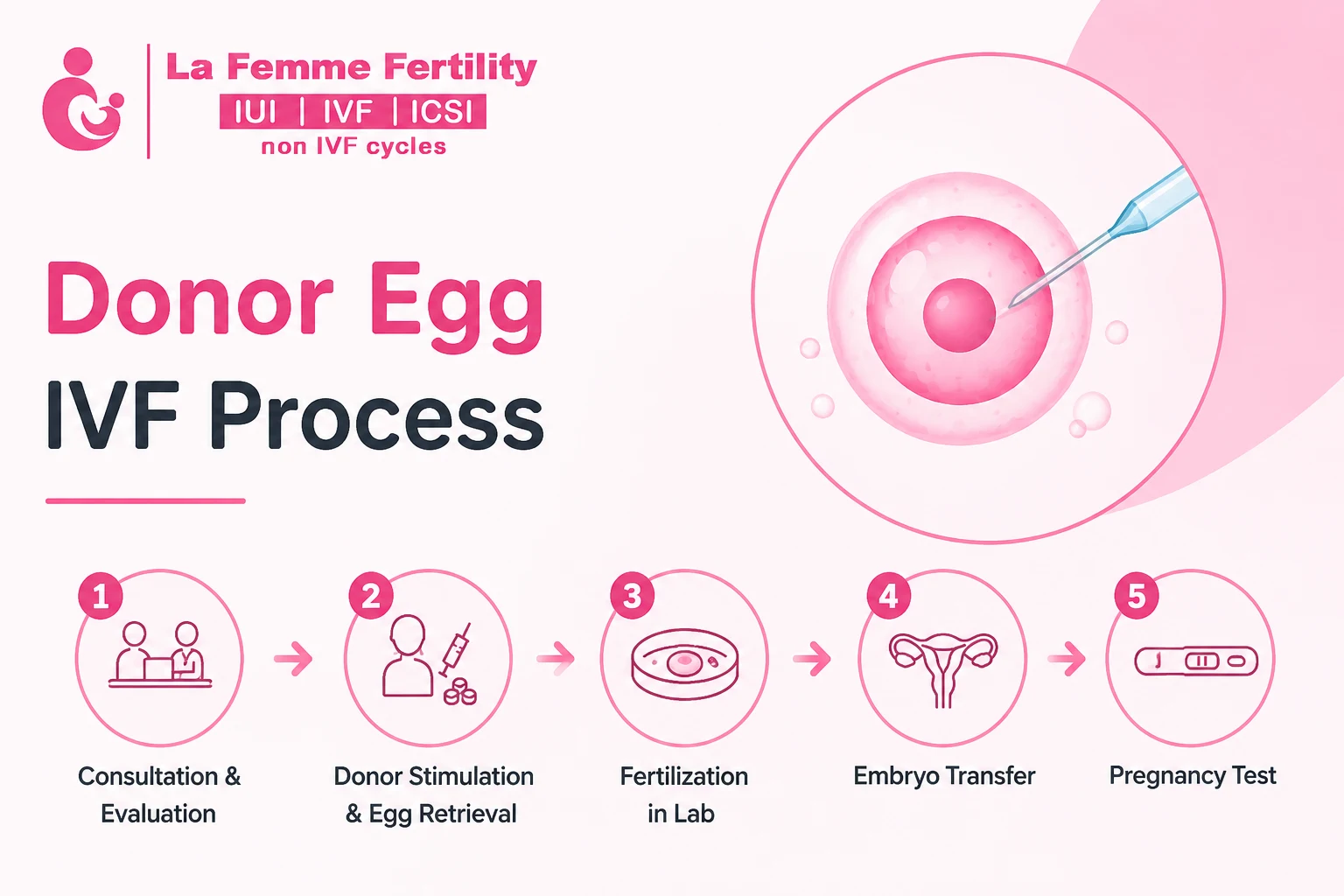
Somewhere between the third failed IVF cycle and the conversation about Donor Egg IVF Process, most women hit a wall. It’s not just a medical decision anymore. It’s an emotional one, and often a hard one to sit with. Donor egg IVF works by using eggs from a screened, healthy donor, fertilising them with the intending father’s sperm (or donor sperm), and transferring the resulting embryo into the recipient’s uterus. At La Femme IVF, Dr. Bhagyashri Naphade walks patients through this decision and the process that follows, one step at a time, without rushing anyone past the parts that feel difficult.
This article breaks down what the donor egg IVF process actually involves, week by week, so you know what’s coming before you start.
Why Donor Eggs Come Into the Picture
Doctors don’t recommend donor eggs lightly. It usually comes up after other options have been tried, or when test results make the odds with a woman’s own eggs genuinely low. The common scenarios:
- Women past 40, where egg quantity and quality have both declined
- Premature ovarian insufficiency, sometimes showing up in women in their late 20s or early 30s
- Repeated IVF cycles that failed despite good embryo transfers, pointing to egg quality as the issue
- Genetic conditions that a woman doesn’t want to risk passing on
- Ovarian damage from chemotherapy, radiation, or surgery
If your AMH levels are low and your last two IVF cycles didn’t result in a pregnancy despite decent-looking embryos, your fertility specialist has probably already mentioned this option. It’s worth hearing out even if it wasn’t what you originally planned for.
Step 1: The First Real Conversation
Before any donor gets selected, there’s a consultation that goes deeper than a standard fertility check-up. Your specialist reviews your full treatment history: how many IVF cycles you’ve done, what protocols were used, why they didn’t work. Blood tests check your hormone levels. An ultrasound looks at your uterine lining and checks for anything, like fibroids or polyps, that might interfere with implantation.
This is also when infection screening happens, and when your partner’s semen analysis gets done, assuming you’re not using donor sperm as well. The point of this stage isn’t the eggs at all. It’s confirming your body is ready to carry a pregnancy once a donor embryo is available.
Step 2: Picking a Donor
This is the part patients tend to have the most questions about. Egg donors go through a screening process that’s more thorough than most people expect. It typically covers:
- Age, usually between 21 and 30, since younger donors tend to produce better quality eggs
- A full reproductive and family medical history
- Genetic carrier screening, to rule out inheritable conditions
- Tests for infectious diseases
- A psychological evaluation, which some clinics skip but shouldn’t
Clinics keep donor profiles on file with non-identifying details such as blood group, height, educational background, and physical features, so recipients can pick someone whose profile feels like a fit. La Femme IVF follows ICMR guidelines here, which means donor anonymity is maintained throughout, and the screening isn’t just a formality.
A lot of patients ask if they can meet the donor. In India, under current regulations, that’s generally not how it works. The process stays anonymous on both sides.
There’s also a choice between a fresh donor cycle and a frozen donor egg bank, and it’s worth understanding the difference before you commit to one. A fresh cycle means a live donor goes through stimulation timed to match yours, which usually gives a higher number of eggs but takes longer to arrange. A frozen egg bank means the eggs are already retrieved, tested, and stored, ready to be thawed and fertilised on your timeline. Frozen eggs tend to have a slightly lower survival rate after thawing, but the process moves faster since there’s no live donor cycle to coordinate around. Your clinic should walk you through both options with actual numbers rather than a blanket recommendation, since which one makes sense depends on your timeline and budget as much as anything medical.
Step 3: Getting Both Cycles in Sync
Once a donor is matched, her cycle needs to line up with yours. The donor starts controlled ovarian stimulation, hormone injections over roughly 10 to 12 days, to get multiple follicles growing at once. Meanwhile your uterine lining is being built up using oestrogen and progesterone, timed so it’s ready right when the embryo needs to go in.
Both sides get monitored closely. Blood tests, ultrasounds, follicle tracking. If the donor’s response to stimulation is slower or faster than expected, timelines shift, and your medication gets adjusted to match. This is normal and not a sign that anything has gone wrong.
If your clinic uses a frozen donor egg bank instead of a fresh cycle, this synchronisation step becomes much simpler, since there’s no live donor cycle to wait on.
Step 4: Egg Retrieval
When the donor’s follicles hit the right size, she gets a trigger injection to finish maturing the eggs. Retrieval happens about 34 to 36 hours after that, under light sedation. It’s quick, usually done in 20 to 30 minutes, using a thin needle guided by ultrasound to collect eggs directly from the ovaries.
Most donors go home the same day and feel back to normal within 24 to 48 hours. Mild cramping or bloating afterward is common and expected.
Step 5: What Happens in the Lab
The retrieved eggs meet sperm in the lab, either through standard IVF insemination or ICSI, where a single sperm is injected directly into the egg. ICSI tends to get used when sperm quality is a factor. Embryologists then watch the fertilised eggs develop over three to five days, grading them and picking the strongest candidates.
If you’ve opted for PGT, genetic testing on the embryos, this is when biopsies happen, before the best embryo is selected for transfer. Not every clinic offers this, and not every patient needs it, but it’s worth asking about if you have a family history of genetic conditions.
Step 6: Embryo Transfer
Transfer day is usually the easiest part, physically speaking. No anaesthesia needed. A thin catheter carries the chosen embryo into your uterus under ultrasound guidance, and the whole thing is over in a few minutes. Most women describe it as similar to a pap smear, uncomfortable at worst, not painful.
You’ll likely be on progesterone support to help the lining stay receptive. Some clinics recommend a short rest afterward; others say normal activity the same day is fine. Ask your specialist what they prefer for your specific case.
Step 7: The Wait, and What Comes After
Roughly 10 to 14 days after transfer, a blood test checks for pregnancy. This wait, sometimes called the two-week wait, is genuinely hard for most people, and it’s fair to expect it to feel that way. If the test is positive, an ultrasound follows two to three weeks later to confirm a heartbeat. Your fertility specialist stays involved through the first trimester before handing care over to an obstetrician.
How Long Does the Whole Thing Take
Start to finish, from choosing a donor to the embryo transfer, most patients are looking at six to eight weeks. That timeline shortens if you’re working from a frozen donor egg bank rather than waiting on a fresh donor cycle, since you skip the synchronisation wait entirely.
Success Rates: What the Numbers Actually Mean
Donor egg IVF tends to have higher success rates than IVF with a woman’s own eggs, mainly because the eggs are coming from young, healthy donors with strong ovarian reserve. But “higher success rate” doesn’t mean guaranteed. Your uterine health, the donor egg quality, and the embryology lab’s standards all play a role. Ask your clinic for their actual numbers, not just industry averages, and talk through what’s realistic for your specific situation during your consultation at La Femme IVF.
A few things tend to move the needle more than people expect. The number of eggs retrieved matters less than how many mature and fertilise well, so a donor with 8 good eggs can sometimes outperform one with 15 where fewer make it to blast stage. The recipient’s uterine lining thickness at transfer time is another factor doctors watch closely, generally aiming for a lining of at least 7 to 8mm before scheduling the transfer. Age still plays a role too, not through the eggs this time, but through how the recipient’s body responds to the hormonal preparation and carries the pregnancy. None of this means you should chase a specific number before agreeing to proceed. It just means the conversation with your specialist should go beyond a single success rate percentage plastered on a website.
The Part Nobody Talks About Enough
There’s a grief that can come with using donor eggs, even when the decision makes complete medical sense. It’s okay to feel that. Some patients find it helps to talk to a counsellor before starting, not because something is wrong with the decision, but because processing it beforehand tends to make the rest of the journey easier to carry.
Partners process this differently too, and not always at the same pace. It’s common for one person to feel ready to move forward while the other needs more time sitting with the idea. Neither reaction is wrong, and rushing the slower partner rarely helps. A good clinic will make space for this conversation rather than treating it as a formality to get through before paperwork.
What Donor Egg IVF Typically Costs
Cost varies by clinic, by whether you’re using a fresh donor cycle or a frozen egg bank, and by whether additional procedures like ICSI or PGT are involved. Fresh donor cycles usually cost more than frozen, partly because of the donor’s stimulation medication and monitoring. It’s worth asking your clinic for a full breakdown upfront, including what happens financially if the first transfer doesn’t result in a pregnancy and a second attempt is needed using frozen embryos from the same cycle. Some clinics bundle this into a shared-risk or refund-style package, others charge per attempt. Understanding this before you start saves a difficult conversation later.
Frequently Asked Questions
1. Is donor egg IVF painful?
For the donor, egg retrieval involves mild sedation and usually just some cramping afterward. For the recipient, embryo transfer doesn’t need anaesthesia and most describe it as mildly uncomfortable rather than painful.
2. Will the baby share my genetics?
Not the egg donor’s genetics, no. The baby will carry genetics from the sperm source, whether that’s your partner or a donor. You carry and deliver the baby, and there’s growing research on how pregnancy itself shapes gene expression through epigenetic factors, even without a direct genetic link.
3. Is donor egg IVF legal in India?
Yes. It’s regulated under the Assisted Reproductive Technology (Regulation) Act, and clinics are expected to follow ICMR guidelines on donor screening, consent, and anonymity.
4. How do I pick the right clinic for this?
Look past the marketing. Ask about their embryology lab’s accreditation, how thorough their donor screening process actually is, and whether they’ll show you real success rate data rather than vague claims. A specialist who takes time to answer your questions in the first consultation is usually a good sign of how the rest of the process will go.
5. Can I choose the donor’s physical characteristics?
Generally yes. Most clinics let you review non-identifying donor profiles covering physical traits, blood group, and educational background, so you can select someone whose profile feels right for your family.
6. What if the first cycle doesn’t work?
It happens, and it doesn’t mean donor eggs were the wrong call. Many clinics recommend having more than one donor cycle’s worth of eggs frozen, precisely so a second attempt doesn’t mean starting the entire donor selection process over.
Consult with Dr Bhagyashri Naphade
La Femme Fertility is a specialist IVF and gynecology clinic in Wakad, Pune, founded by Dr. Bhagyashri Naphade – an ASRM award-winning infertility specialist with over 20 years’ experience, 50+ research publications and 12 years at Apollo Cradle, Bangalore. The clinic specializes in IVF, PCOD, laparoscopy, and cosmetic gynecology.

Dr. Bhagyashree Naphade
Dr. Bhagyashri Naphade is a highly trusted lady gynecologist and IVF specialist in Wakad, Pune, with an overall 20 years of practice and 10 years of experience as a gynecologist IVF specialist. Internationally trained in IVF from Germany and an ASRM award winner, she specializes in IVF, IUI, PCOD/PCOS, and women’s health.
