
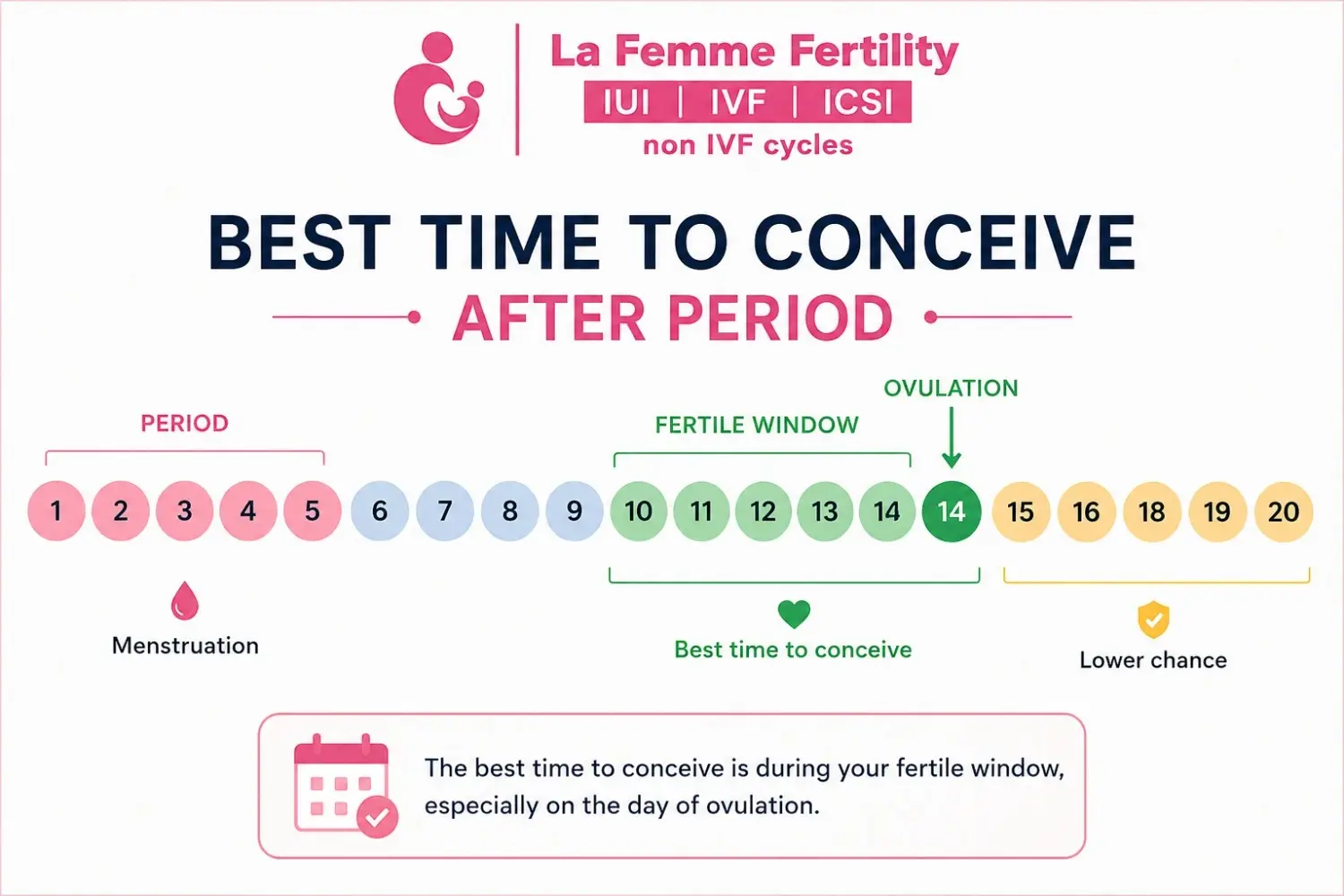
The best time to try to conceive is typically 10 to 16 days after the first day of your period, which marks your fertile window. For most women with a 28-day cycle, ovulation occurs around day 14. Having intercourse on the 2 to 3 days before ovulation gives the highest pregnancy success rates.
If you are planning a pregnancy, timing matters more than most people realise. The human egg survives for only 12 to 24 hours after ovulation, while sperm can live inside the reproductive tract for up to five days. This short biological window means that knowing exactly how many days after your period to try to conceive can be the difference between success and another month of waiting.
This guide explains the science of your menstrual cycle, how to calculate your fertile window, what affects ovulation timing, and how to maximise your chances whether your cycle is regular or irregular. For personalised fertility support in Pune, Dr. Bhagyashri Naphade at La Femme IVF offers expert consultation at Wakad and Viman Nagar.
Understanding Your Menstrual Cycle and Why Timing Matters
Your menstrual cycle is counted from Day 1 of your period (the first day of full bleeding) to the day before your next period begins. The average cycle is 28 days, but cycles between 21 and 35 days are perfectly normal.
The cycle has two main phases divided by ovulation:
- Follicular phase (Day 1 to ovulation): Oestrogen rises, the uterine lining thickens, and follicles in the ovary mature. One dominant follicle eventually releases an egg.
- Luteal phase (ovulation to next period): Progesterone rises to prepare the uterine lining for implantation. This phase is almost always 12 to 14 days long, regardless of total cycle length.
Because the luteal phase length is fixed, if your cycle is longer or shorter than 28 days, the variation happens in the follicular phase. That is why ovulation day shifts with cycle length.
How Many Days After Your Period Is Best to Try to Conceive?
The fertile window spans roughly six days: the five days before ovulation and ovulation day itself. Within this window, your three highest-probability days are the two days before ovulation and ovulation day itself.
| Cycle Length | Ovulation Day | Fertile Window Starts | Best Days to Try |
| 21 days | Day 7 | Day 2 | Days 5, 6, 7 |
| 24 days | Day 10 | Day 5 | Days 8, 9, 10 |
| 28 days | Day 14 | Day 9 | Days 12, 13, 14 |
| 30 days | Day 16 | Day 11 | Days 14, 15, 16 |
| 35 days | Day 21 | Day 16 | Days 19, 20, 21 |
Source: Industry estimate based on standard luteal phase of 14 days
The simple formula to find your estimated ovulation day is:
Ovulation day = Cycle length minus 14
So for a 30-day cycle: 30 minus 14 equals Day 16. The three best days to try to conceive would then be Days 14, 15, and 16. Having sex on all three days is more effective than saving it for ovulation day alone, as studies show peak pregnancy rates when intercourse occurs two days before ovulation.
Not sure when you ovulate? Dr. Bhagyashri Naphade at La Femme IVF, Wakad and Viman Nagar, offers personalised ovulation tracking and fertility assessments. Visit www.lafemmeivf.in to book a consultation.
How to Know When You Are Actually Ovulating
Calendar calculation is a starting point, not a guarantee. Here are the physical signs that confirm ovulation is happening:
- Cervical mucus changes: Around ovulation, discharge becomes clear, stretchy, and similar to raw egg white. This texture helps sperm travel to the egg. If you notice this change, you are in your fertile window.
- Basal body temperature (BBT) rise: Your resting body temperature rises by 0.2 to 0.5 degrees Celsius immediately after ovulation. Tracking BBT over several months helps you predict future cycles, but the rise confirms ovulation has already occurred.
- Mittelschmerz: About 20% of women feel a mild twinge or ache on one side of the lower abdomen at ovulation. This pain lasts from a few minutes to a few hours.
- LH surge on OPKs: Ovulation predictor kits detect the luteinising hormone surge that triggers ovulation. A positive OPK means ovulation will occur within 24 to 36 hours. This is your green light to have intercourse that day and the next.
What If Your Cycle Is Irregular? How to Time Intercourse Without a Fixed Ovulation Day
Irregular cycles make calendar-based predictions unreliable. If your cycles vary by more than seven days from month to month, consider these approaches:
- Use OPKs daily from Day 8 or 9: Start testing early so you do not miss a short cycle. Test at the same time each day, ideally between 10 am and 8 pm.
- Track cervical mucus consistently: This method works independently of cycle length and directly reflects hormonal changes happening in your body right now.
- Use a fertility monitor: Digital fertility monitors track both oestrogen and LH, giving a wider fertile window prediction. They are more accurate than simple OPKs for women with irregular cycles.
- Have sex every two to three days throughout your cycle: For very unpredictable cycles, consistent intercourse every two to three days ensures sperm are always present when ovulation eventually occurs.
Common Mistakes People Make When Trying to Conceive
- Waiting until ovulation day: The egg lives for just 12 to 24 hours. If sperm are not already waiting in the fallopian tubes when the egg arrives, fertilisation becomes unlikely. Start having intercourse two to three days before your predicted ovulation day.
- Counting Day 1 as the last day of your period: Day 1 is the first day of full menstrual bleeding, not the last day. Miscounting by even two to three days can shift your entire fertile window calculation.
- Assuming every cycle is 28 days: Only about 13% of women have exactly 28-day cycles (industry estimate). If your cycle is 25 days, ovulation is around Day 11, not Day 14.
- Having sex only once at ovulation: Research published in the New England Journal of Medicine found the highest conception rates when intercourse occurred two days before ovulation, not on ovulation day alone.
Struggling with irregular cycles or uncertain ovulation timing? Book a fertility consultation with Dr. Bhagyashri Naphade at La Femme IVF, Wakad and Viman Nagar, Pune.
Lifestyle Factors That Affect When You Ovulate
Ovulation timing is not fixed in stone. Several lifestyle and health factors can shift it earlier or later:
- Stress: High cortisol levels can suppress the LH surge and delay or prevent ovulation. Even a stressful month can push your ovulation day later than usual.
- Illness or travel: Fever, jet lag, or physical illness during the follicular phase can delay follicle maturation and push ovulation back by several days.
- Thyroid disorders: Both hypothyroidism and hyperthyroidism can disrupt menstrual cycles and ovulation. If your cycles are consistently irregular, thyroid function is one of the first things a fertility doctor will check.
- PCOS: Polycystic ovary syndrome is one of the leading causes of irregular or absent ovulation. If you have PCOS, calendar-based timing alone is unreliable and OPKs may give false positives due to elevated LH levels.
- Extreme exercise or low body weight: Very low body fat can suppress oestrogen production and stop ovulation altogether (hypothalamic amenorrhoea).
Frequently Asked Questions About the Best Time to Try to Conceive After Your Period
Can you get pregnant right after your period ends?
Yes, it is possible, especially if you have a short cycle. If your period lasts seven days and your cycle is 21 days, ovulation can occur as early as Day 7. Sperm deposited during your period could survive long enough to fertilise the egg. While the probability is low, it is not zero.
How many days after your period do you ovulate?
On a 28-day cycle, ovulation occurs roughly 14 days after the first day of your period. On shorter cycles of 21 to 24 days, ovulation happens between Days 7 and 10. On longer cycles of 30 to 35 days, it shifts to Days 16 to 21. The formula is: cycle length minus 14 equals your estimated ovulation day.
Is Day 10 after your period a good day to try to conceive?
It depends on your cycle length. For women with cycles of 24 to 25 days, Day 10 falls within the fertile window and is an excellent day to try. For women with 28-day cycles, Day 10 is slightly early but still productive since sperm survive for up to five days. If your cycle is 35 days, Day 10 is too early for peak fertility.
Does having sex every day during the fertile window improve chances?
Daily intercourse during the fertile window does not significantly improve chances over every-other-day intercourse and may reduce sperm count in some men. Research suggests that having sex every one to two days throughout the fertile window gives optimal results. More frequent sex is only beneficial if sperm count is confirmed to be healthy.
What happens if you miss your fertile window?
If you miss your fertile window, pregnancy is not possible in that cycle. However, do not stress. One missed cycle is common and does not indicate a problem. Use that month to track your cervical mucus, BBT, or OPK results more carefully so you are better prepared the following cycle.
Can stress delay ovulation and affect when you should try to conceive?
Yes. Stress raises cortisol, which can suppress GnRH and delay the LH surge responsible for triggering ovulation. This means your fertile window arrives later than predicted by your usual cycle length. If you are going through a stressful period, use OPKs rather than relying on calendar counting alone.
How long should we try before seeing a fertility specialist?
If you are under 35 and have been trying with timed intercourse for 12 months without success, it is time to see a fertility specialist. If you are 35 or older, seek evaluation after six months. If you have irregular periods, a known condition like PCOS or endometriosis, or a history of pelvic inflammatory disease, consult a specialist earlier. La Femme IVF in Pune offers early fertility assessments with no long waiting periods.
Do OPKs work for everyone?
OPKs work well for most women but can give misleading results in women with PCOS (elevated baseline LH causing false positives), women over 40 (elevated FSH can affect readings), and women with very short LH surges who may miss the peak if testing only once daily. Fertility monitors that track both LH and oestrogen provide more reliable results in these cases.
Does the time of day of intercourse matter for conception?
There is no conclusive evidence that the time of day significantly affects conception rates. What matters most is the timing relative to ovulation. Some research suggests sperm quality may be slightly higher in the morning for some men. Focus on the fertile window days rather than the clock.
Can lubricants affect your chances of getting pregnant?
Yes. Many standard lubricants, including KY Jelly and saliva, can reduce sperm motility. If you use lubrication, choose fertility-friendly options such as Pre-Seed, Conceive Plus, or mineral oil, which are shown to be sperm-compatible in laboratory studies.
When Should You See a Fertility Specialist in Pune?
Timing intercourse correctly is important, but it is not the only factor in conception. You should consult a gynaecologist or fertility specialist if:
- You have been trying for 12 months (under 35) or six months (35 and older) without success
- Your periods are very irregular or absent
- You have a diagnosis of PCOS, endometriosis, or thyroid disorder
- You have had two or more miscarriages
- Your partner has a history of low sperm count or motility issues
Early evaluation can identify treatable causes quickly and prevent months of unnecessary waiting. Dr. Bhagyashri Naphade at La Femme IVF, with clinics in Wakad and Viman Nagar, Pune, provides comprehensive fertility work-ups tailored to each couple.
Days 12 to 16 Are Your Best Window for Most Women
For most women with cycles between 26 and 32 days, the best days to try to conceive fall between Days 10 and 16 after the first day of your period. The peak probability days are two to three days before ovulation and ovulation day itself.
Do not leave timing to guesswork. Track your cycle length for at least two to three months, watch for cervical mucus changes, and consider using OPKs to confirm your LH surge. The combination of calendar awareness and physical signs gives you the best possible chance of conception each cycle.
If you are in Pune and want expert guidance, La Femme IVF at Wakad and Viman Nagar offers everything from ovulation tracking to full IVF Treatment cycles under one roof, led by Dr. Bhagyashri Naphade.
Book a Fertility Consultation at La Femme IVF
Ready to find out exactly when you ovulate and maximise your chances of getting pregnant? Dr. Bhagyashri Naphade and the team at La Femme IVF offer personalised fertility assessments, ovulation tracking, and complete IVF care in Pune.
| La Femme IVF, Wakad Wakad, Pune 411057 | La Femme IVF, Viman Nagar 2 Viman Nagar, Pune 411014 |

Dr. Bhagyashree Naphade
Dr. Bhagyashri Naphade is a highly trusted lady gynecologist and IVF specialist in Wakad, Pune, with an overall 20 years of practice and 10 years of experience as a gynecologist IVF specialist. Internationally trained in IVF from Germany and an ASRM award winner, she specializes in IVF, IUI, PCOD/PCOS, and women’s health.
