
Published by Dr. Bhagyashri Naphade | La Femme Fertility Clinic, Wakad, Pune | Updated July 2025
When couples come to La Femme Fertility Clinic asking about IVF, one of the first questions that comes up is this one: how many embryos actually go back in? It is a completely fair thing to wonder. The number affects your chances of success, your risk of twins, and quite honestly, the whole emotional weight of the cycle.
The short answer is that most clinics in India today transfer one or two embryos per cycle. But the actual number chosen for you will depend on your age, the quality of the embryos that developed in the lab, your health history, and the guidance of your fertility specialist. There is no universal rule, and that is exactly why it is worth understanding what goes into the decision.
This guide walks you through how embryo transfer decisions are made, what the research says about single versus double transfers, and what you can realistically expect during this stage of IVF.
What Is an Embryo Transfer in IVF?
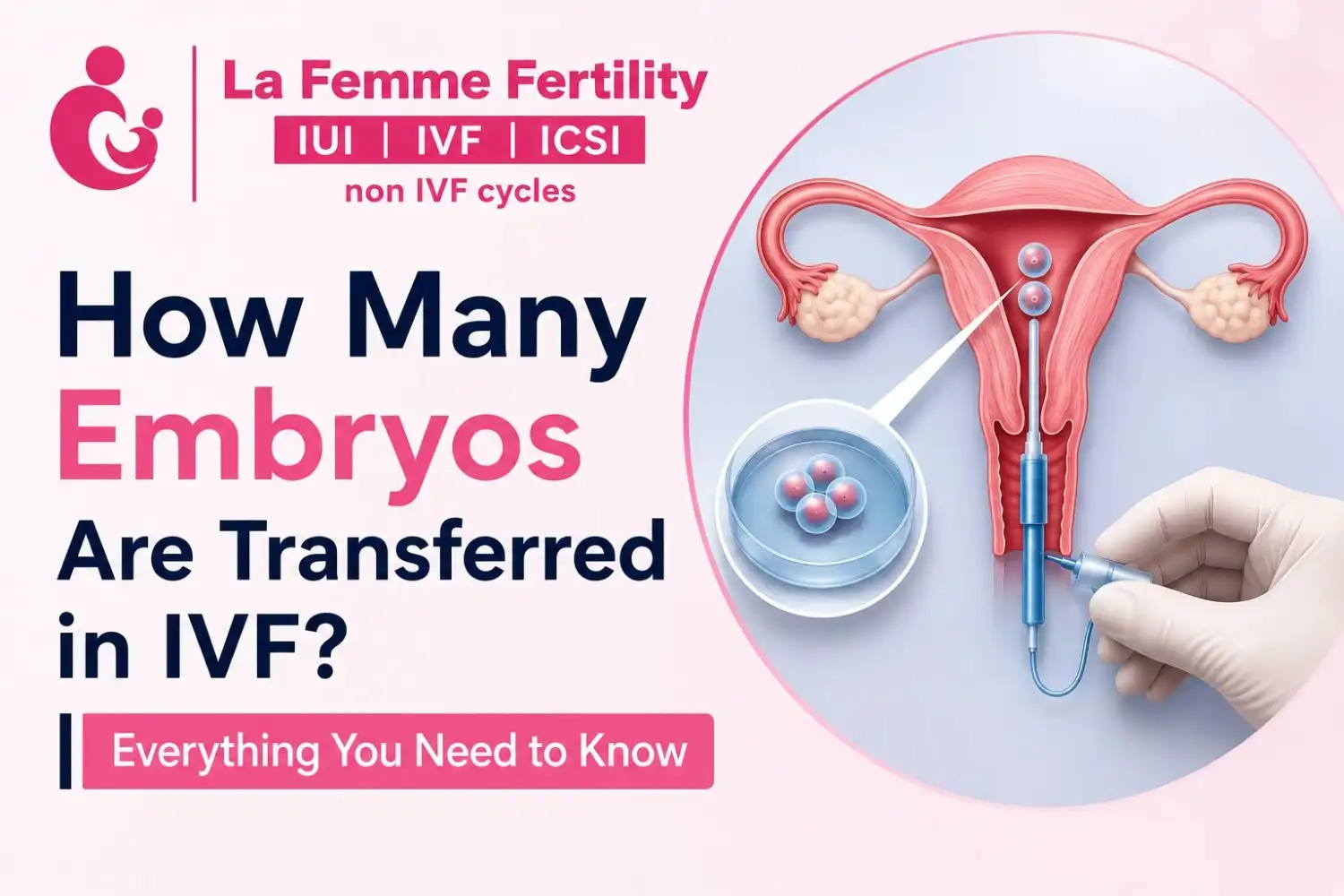
An embryo transfer is the final step in an IVF cycle. After the eggs are retrieved and fertilised in the laboratory, the resulting embryos are observed and graded over three to five days. The best ones are selected, and a thin catheter is used to place them gently inside the uterus through the cervix. The entire process takes about ten to fifteen minutes and does not require anaesthesia.
What happens next is largely out of the doctor’s hands. The embryo either implants into the uterine lining or it does not. This is why the choice of how many to transfer matters so much.
How Many Embryos Are Transferred During IVF?
In current practice at most reputable fertility centres, the standard is to transfer one to two embryos. International reproductive guidelines, including those from the American Society for Reproductive Medicine (ASRM) and the European Society for Human Reproduction and Embryology (ESHRE), have moved firmly toward fewer embryos per transfer, especially in younger patients.
Here is a general breakdown of what most clinics follow based on age and embryo quality:
| Patient Age | Embryo Quality | Typical Transfer Number |
| Under 35 | High quality blastocyst | 1 embryo (eSET) |
| Under 35 | Average or mixed quality | 1 to 2 embryos |
| 35 to 37 | Good quality | 1 to 2 embryos |
| 38 to 40 | Variable quality | 2 embryos |
| Over 40 | Often lower quality | 2 to 3 embryos (case by case) |
| Any age, donor eggs | Typically high quality | 1 to 2 embryos |
These are guidelines, not rigid rules. A fertility doctor who knows your full history will always make the final call in consultation with you.
Single Embryo Transfer vs. Double Embryo Transfer: What Is the Difference?
This is probably the most common question couples ask after they understand the basics of IVF. Both approaches have a place in treatment, and neither is automatically better.
Single Embryo Transfer (SET)
A single embryo transfer means one embryo is placed into the uterus per cycle. When the embryo selected is a high-grade blastocyst, the pregnancy rate per transfer can be comparable to double transfer, while essentially eliminating the risk of a twin pregnancy.
The biggest advantage of SET is safety. Twin pregnancies carry higher rates of premature birth, low birth weight, and complications for both the mother and the babies. Many fertility doctors in Pune now actively encourage SET for younger patients with good embryo quality.
If the first cycle does not succeed, any frozen embryos from the same retrieval can be used in a frozen embryo transfer cycle, giving multiple chances without going through the full stimulation process again.
Double Embryo Transfer (DET)
Two embryos are transferred in the same cycle. This approach can improve the per-cycle success rate, which is why it tends to be recommended when embryo quality is lower, when a patient has had one or more failed cycles, or when the patient is older and the chance of each embryo implanting is lower.
The trade-off is a meaningful risk of twins. Across IVF cycles globally, twin pregnancies account for roughly 15 to 25 percent of DET outcomes, which is far higher than the natural twin rate. This is worth a detailed conversation with your doctor before deciding.
IVF Embryo Transfer Options: A Quick Comparison
| Transfer Type | Who It’s For | Success Rate Edge | Risk |
| Single Embryo Transfer (SET) | Women under 35, good quality blastocyst | Lower per cycle, higher cumulative | Near-zero twins |
| Double Embryo Transfer (DET) | Women 35-40, previous failures, weaker embryos | Higher per cycle | 15-20% twin risk |
| Frozen Embryo Transfer (FET) | Surplus embryos from prior cycle | Often equal or better than fresh | Extra preparation cycle |
| Day 3 vs Day 5 Transfer | Day 5 (blastocyst) preferred where possible | Better selection accuracy | Some embryos may not reach Day 5 |
What Factors Does a Doctor Consider When Deciding How Many Embryos to Transfer?
There is no single formula. Doctors weigh several things together before recommending a number:
- Age of the patient: Younger women generally have better embryo quality and a higher chance of implantation from fewer embryos.
- Embryo grade and stage: Blastocysts graded on expansion, inner cell mass quality, and trophectoderm quality will influence how many are needed.
- History of previous IVF attempts: Someone who has had two or three failed cycles may benefit from transferring two embryos even if she is young.
- Uterine conditions: Fibroids, polyps, a thin endometrial lining, or adenomyosis can affect implantation rates regardless of embryo quality.
- Underlying diagnosis: Conditions like PCOD, endometriosis, or low ovarian reserve each affect the IVF picture differently.
- Fresh vs. frozen cycle: Evidence increasingly shows that frozen embryo transfers may outperform fresh transfers in some patients, partly because the uterus has time to recover from stimulation.
- Patient preference after informed discussion: Some patients, after understanding the risks of multiples, actively choose SET. Others feel strongly about maximising their per-cycle chance. Both positions are valid when made with full information.
Day 3 vs. Day 5 Embryo Transfer: Which Is Better?
After fertilisation, embryos are observed in the laboratory for either three or five days before transfer. The five-day embryo, called a blastocyst, has developed significantly further than the three-day cleavage-stage embryo.
Most modern fertility clinics prefer Day 5 transfers when possible. The reasons are practical:
- A blastocyst has already proved it can keep developing, so selection is more accurate.
- The timing of a Day 5 transfer is better synchronised with the natural window of uterine implantation.
- Genetic testing (PGT-A) is only possible at the blastocyst stage.
That said, not all embryos survive to Day 5 in the lab. Some develop better inside the body. For patients with fewer fertilised eggs, a Day 3 transfer may still be the right call. Your embryologist and fertility doctor will assess this together.
What Happens to Unused Embryos After Transfer?
Any embryos that were not transferred and are of sufficient quality are usually frozen through a process called vitrification. This is a rapid-cooling technique that preserves the embryo’s structure far better than older slow-freeze methods.
Frozen embryos can be stored for several years. When you are ready for another attempt, whether because the first transfer did not result in pregnancy or because you want a second child, these embryos can be thawed and transferred in what is called a frozen embryo transfer (FET) cycle. The preparation for FET is less intensive than a full IVF cycle because you skip the stimulation and egg retrieval stages.
Research in recent years has shown that FET success rates are often equal to, and in some cases better than, fresh transfers. Part of this is because the uterus has recovered from ovarian stimulation and is in a more natural state.
What Does Indian Law Say About IVF Embryo Transfer?
The Assisted Reproductive Technology (Regulation) Act, 2021 is the governing framework for IVF practice in India. Under the Act, there are restrictions on the number of embryos that can be created and transferred, with patient safety and ethical considerations built into the guidelines.
In practice, most clinics in Pune and across India follow ICMR and ASRM guidelines, which recommend limiting transfers to one to two embryos in most cases and strictly no more than three in any patient. These limits exist to prevent high-order multiple pregnancies, which carry serious health risks for both the mother and children.
IVF Embryo Transfer in Pune: What to Expect at La Femme Fertility Clinic
At La Femme Fertility Clinic in Wakad, PCMC, the approach to embryo transfer is built around what is appropriate for each individual patient rather than a standard protocol applied to everyone.
Dr. Bhagyashri Naphade and her team spend time before the transfer day reviewing embryo grades with you, explaining what was seen in the laboratory, and walking through the reasoning behind the transfer recommendation. Patients are encouraged to ask questions. The goal is that you understand exactly what is happening and why, not just that it is happening.
The transfer itself is done under ultrasound guidance for accuracy. Most patients describe it as no more uncomfortable than a routine pelvic examination. After the procedure, you will rest briefly at the clinic before going home. Physical activity is modestly restricted for a few days, and progesterone support continues as prescribed.
The two-week wait for results is genuinely difficult, and the team at La Femme acknowledges that. A beta-hCG blood test is scheduled around 10 to 14 days after transfer to confirm whether pregnancy has occurred.
Embryo Transfer?
The Assisted Reproductive Technology (Regulation) Act, 2021 is the governing framework for IVF practice in India. Under the Act, there are restrictions on the number of embryos that can be created and transferred, with patient safety and ethical considerations built into the guidelines.
In practice, most clinics in Pune and across India follow ICMR and ASRM guidelines, which recommend limiting transfers to one to two embryos in most cases and strictly no more than three in any patient. These limits exist to prevent high-order multiple pregnancies, which carry serious health risks for both the mother and children.
IVF Embryo Transfer in Pune: What to Expect at La Femme Fertility Clinic
At La Femme Fertility Clinic in Wakad, PCMC, the approach to embryo transfer is built around what is appropriate for each individual patient rather than a standard protocol applied to everyone.
Dr. Bhagyashri Naphade and her team spend time before the transfer day reviewing embryo grades with you, explaining what was seen in the laboratory, and walking through the reasoning behind the transfer recommendation. Patients are encouraged to ask questions. The goal is that you understand exactly what is happening and why, not just that it is happening.
The transfer itself is done under ultrasound guidance for accuracy. Most patients describe it as no more uncomfortable than a routine pelvic examination. After the procedure, you will rest briefly at the clinic before going home. Physical activity is modestly restricted for a few days, and progesterone support continues as prescribed.
The two-week wait for results is genuinely difficult, and the team at La Femme acknowledges that. A beta-hCG blood test is scheduled around 10 to 14 days after transfer to confirm whether pregnancy has occurred.
Frequently Asked Questions About IVF Embryo Transfer
In most clinics across India, including those in Pune, one to two embryos are typically transferred. The number depends on the patient’s age, embryo quality, and whether this is a first or repeat attempt.
A Day 3 (cleavage-stage) embryo has divided into roughly 6 to 8 cells. A Day 5 embryo, or blastocyst, has continued to develop and contains more cells with a clearer structure. Blastocysts allow for better selection, which is why most clinics prefer Day 5 transfers where possible.
A blood test measuring beta-hCG levels is done about 10 to 14 days after the transfer. A positive result confirms pregnancy. Early symptoms like mild cramping or breast tenderness may appear, but these can overlap with medication side effects.
Yes, especially when a good-quality blastocyst is transferred. Many successful IVF pregnancies at La Femme and similar clinics have resulted from a single embryo, with additional embryos frozen for future cycles.
Remaining viable embryos are cryopreserved (frozen) using a technique called vitrification. These can be used in future frozen embryo transfer cycles if the first attempt does not succeed or if you want a second child.
Yes. Elective single embryo transfer significantly reduces the chance of twins. In younger patients with high-quality embryos, most reproductive specialists now recommend SET to avoid the health risks of multiple pregnancies.
GET IN TOUCH
Schedule a Visit

Dr. Bhagyashree Naphade
Dr. Bhagyashri Naphade is a highly trusted lady gynecologist and IVF specialist in Wakad, Pune, with an overall 20 years of practice and 10 years of experience as a gynecologist IVF specialist. Internationally trained in IVF from Germany and an ASRM award winner, she specializes in IVF, IUI, PCOD/PCOS, and women’s health.
